
About Author: Anthony Neal Macri is a marketing executive with over 15 years of experience leading digital marketing, SEO, and growth initiatives across startups and global organizations. His work focuses on AI-driven content operations, localization strategy, and scaling marketing systems across international markets. He currently serves as Chief Marketing Officer at LanguageCheck.ai, where he works with multilingual teams navigating quality, consistency, and governance challenges in AI-powered workflows.
AI has solved content scale. Quality assurance — especially in multilingual marketing — is now the hidden bottleneck.
AI has removed one of the biggest historical bottlenecks in marketing: content production.
Campaigns that once took weeks can now be planned, written, localized, and launched in days — sometimes hours.
But as AI content velocity accelerates, a less visible problem is emerging beneath the surface: quality assurance hasn’t scaled at the same pace, particularly in multilingual marketing.
This gap is already affecting brand trust, compliance, and performance — often without teams realizing it until damage is done.
AI Solved Content Speed — Not Content Validation
For years, marketing teams struggled with output. AI solved that decisively.
Today, the challenge isn’t creating content. It’s knowing whether that content still says what you think it says once it travels across languages, markets, and channels.
Most AI marketing stacks are optimized for:
- Ideation
- Generation
- Distribution
Very few are designed for validation.
In a single-language environment, this is risky. In a global one, it compounds quickly.
Why Translation Errors Are Harder to Catch Than Content Errors
A poorly written English headline is easy to spot.
A poorly translated headline usually isn’t.
Modern AI translations are fluent by default. They read well, flow naturally, and rarely look wrong at first glance — even when meaning has shifted.
This creates false confidence:
- The sentence sounds right
- Grammar is clean
- Tone feels acceptable
Yet intent, emphasis, or terminology may already be drifting.
For regulated industries, this becomes a compliance issue.
For performance marketing, a conversion issue.
For brand marketing, a long-term trust issue.
AI Increased Localization Volume — But Not Review Capacity
Before AI, localization workflows were slower and smaller.
Human review worked because the volume was manageable.
That equation no longer holds.
Today, teams are dealing with:
- Dozens of campaigns
- Hundreds of assets
- Multiple variants
- Multiple languages
- Continuous optimization cycles
Manual QA simply doesn’t scale across this volume. As a result, teams rely on spot checks, selective reviews, or assumptions — none of which are reliable safeguards.
Why “Human-in-the-Loop” Alone Is No Longer Enough
“Human-in-the-loop” is directionally correct — but operationally incomplete.
Humans excel at judgment and nuance.
They are not optimized for consistent, high-volume linguistic validation at speed.
When QA relies solely on people:
- Reviewer fatigue increases error rates
- Terminology drifts across regions
- Standards vary by individual and market
Ironically, AI-generated content often ends up being reviewed less rigorously than pre-AI content — simply because there is more of it.
The Emerging Role of AI in Translation Quality Assurance
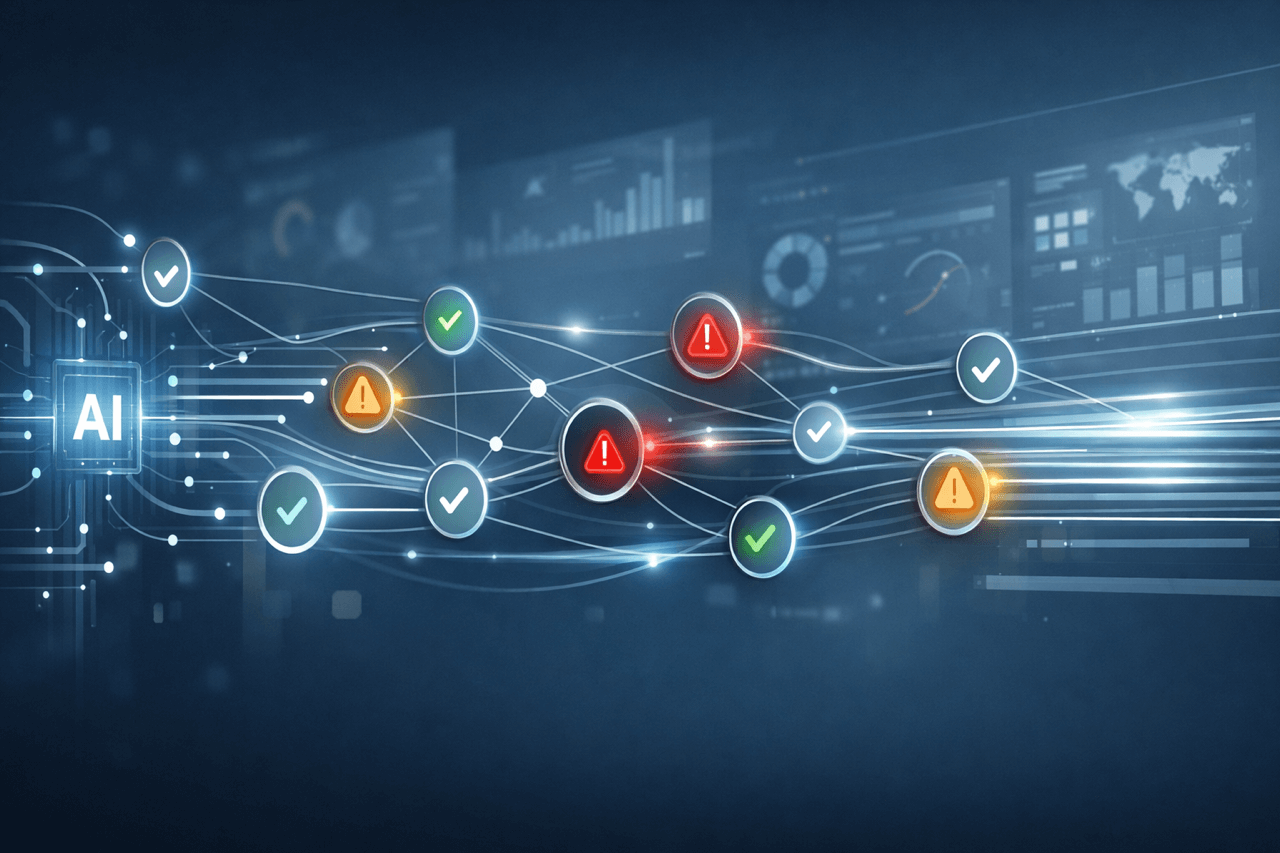
To close this gap, some teams are now using AI not to generate content — but to check it.
This reframes the role of AI in marketing workflows.
Instead of asking:
“Can AI produce this content?”
Teams are asking:
“Can AI help verify meaning, intent, and terminology consistency?”
In multilingual environments, this means:
- Segment-level meaning comparison
- Detection of semantic drift
- Terminology alignment across markets
- Risk scoring instead of blanket review
Some teams experiment with AI-based translation QA platforms — including category solutions like LanguageCheck.ai — to surface only the segments that actually require human attention before publication.
The value isn’t automation.
It’s focus.
What a Scalable Multilingual QA Layer Looks Like
Teams adapting successfully tend to share a few traits:
- QA happens before content goes live
- Validation is selective, not exhaustive
- Human reviewers intervene where risk is detected
- Quality is measured over time, not assumed
This turns QA from a cost center into operational infrastructure.
Control Is Becoming a Competitive Advantage in AI Marketing
Speed is no longer rare.
Content volume is no longer impressive.
What is becoming scarce is confidence:
- Confidence that messaging is consistent globally
- Confidence that brand voice survives localization
- Confidence that AI hasn’t introduced silent risk
As AI adoption matures, quality control is moving from an afterthought to a differentiator.
Scale Without Validation Is Just Risk
AI didn’t eliminate the need for quality assurance.
It exposed the cost of ignoring it.
Marketing teams that treat QA as a secondary concern will eventually pay for it — in trust, performance, or credibility.
The future of AI marketing won’t be defined by what teams can generate.
It will be defined by what they can stand behind.